Description
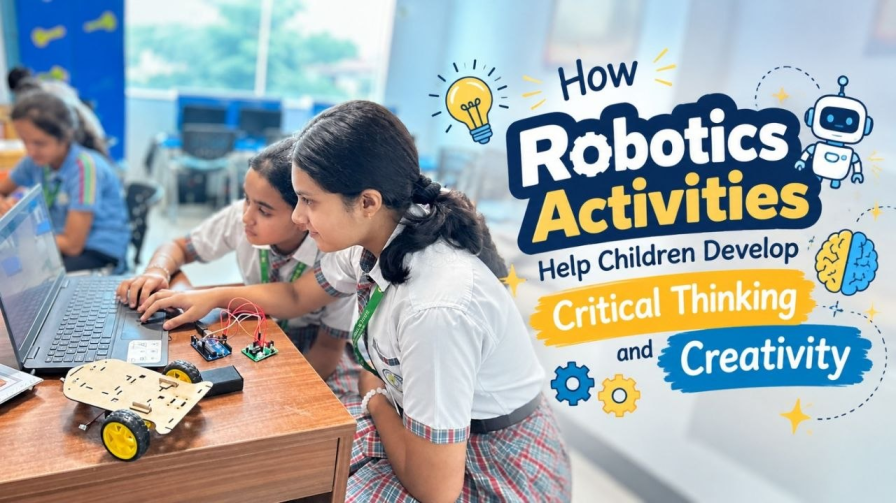
How Robotics Activities Help Children Develop Critical Thinking and Creativity
In a world where technology is becoming part of everyday life, children need more than textbook knowledge. They need to know how to think, question, experiment, solve problems, and create new ideas. This is where robotics activities can make learning more engaging and meaningful.
Robotics combines concepts from science, technology, engineering, mathematics, and coding with hands-on activities. Instead of simply learning how something works, children can build, test, make mistakes, and try again.
For students at Ompee Global School in Manesar, Gurgaon, robotics and technology-based learning can complement an experiential approach that encourages curiosity, creativity, critical thinking, and real-world application.
What Are Robotics Activities for Children?
Robotics activities involve designing, building, programming, or controlling robots to complete specific tasks or solve challenges.
Depending on the child's age, activities can include:
Building simple robotic models
Programming a robot to follow a path
Creating obstacle-avoiding robots
Using sensors and motors
Solving simple coding challenges
Designing robots for real-life problems
Working on team-based STEM projects
The important part is not just building a robot. It is the thinking process behind the project—understanding a problem, planning a solution, testing it, identifying mistakes, and improving the design.
Research from NCERT's Central Institute of Educational Technology describes robotics-based learning as an integrated STEM/STEAM approach involving designing, building, testing, and refining solutions while developing skills such as critical thinking, creativity, collaboration, and technological literacy.
1. Robotics Encourages Critical Thinking
Critical thinking means looking at a problem carefully before deciding what to do.
When children work on a robotics project, they may ask:
Why isn't the robot moving?
Why did it turn in the wrong direction?
Which sensor should be used?
What can we change to make it work better?
These questions encourage children to analyse information rather than simply memorise an answer.
For example, if a robot fails to reach its destination, students need to identify where the problem occurred. They may change the code, adjust the sensor, modify the structure, and test the robot again.
This process naturally develops logical reasoning and problem-solving skills.
2. Children Learn Through Trial and Error
One of the most valuable lessons robotics can teach is that making a mistake is part of learning.
A robot may not work correctly on the first attempt. Instead of giving up, children can investigate what went wrong and try another approach.
This creates a learning cycle:
Plan → Build → Test → Identify the Problem → Improve → Test Again
Such hands-on learning can make children more comfortable with experimentation and encourage them to look for solutions instead of immediately expecting the correct answer.
3. Robotics Gives Creativity a Practical Direction
Creativity is not limited to drawing, writing, or making art. Children can also express creativity by designing solutions to problems.
Imagine asking students:
"Can you design a robot that can help people in a particular situation?"
There may be many possible answers.
One child might design a cleaning robot. Another might create a robot for delivering objects, while another might imagine a robot that helps elderly people.
Robotics gives children a platform where imagination can become something they can build, test, and improve.
A meta-analysis of K–12 research found positive effects of educational robotics on creativity and problem-solving, although the effects can vary depending on factors such as age and instructional design.
4. It Develops Problem-Solving Skills
Every robotics challenge starts with a problem.
For example:
"How can we make the robot move from Point A to Point B without touching an obstacle?"
Students have to think about the route, sensors, movement, programming, and design.
There may not be only one solution. This encourages children to compare different approaches and understand why one solution works better in a particular situation.
Research on robotic coding education has also reported improvements in problem-solving and aspects of creative thinking among preschool children participating in robotics and coding activities.
5. Robotics Makes STEM Learning More Interactive
Science and mathematics can sometimes feel abstract when students only read about concepts in textbooks.
Robotics can give these concepts a practical context.
For example:
Mathematics: angles, measurements, distance and patterns
Science: force, motion, energy and sensors
Technology: digital tools and programming
Engineering: designing and improving structures
Coding: instructions, sequences and logical thinking
This makes robotics a natural part of STEM learning for children.
Research published in the International Journal of STEM Education found that educational robotics had moderate-sized effects on STEM learning compared with non-robotics conditions, while also noting that outcomes depend on instructional factors.
6. Children Learn to Collaborate
Robotics projects are often more enjoyable when children work together.
One student may work on the design, another on coding, and another on testing the robot. They have to communicate their ideas, listen to others, and decide how to solve challenges together.
This develops important skills such as:
Communication
Teamwork
Leadership
Collaboration
Decision-making
Listening
Sharing ideas
Recent research on educational robotics has also explored connections between communication, collaboration, critical thinking, and creativity, particularly in early childhood learning.
7. Robotics Builds Confidence Through Hands-On Learning
There is a special sense of achievement when a child builds something and watches it work.
A simple robot completing a task can give students the confidence to say:
"I created this."
That feeling can encourage children to take on more challenging projects.
At Ompee Global School, the broader educational approach focuses on helping students become confident, curious, creative, responsible learners through experiential learning, communication, technology-enabled learning, and skill-building experiences.
8. Robotics Connects Classroom Learning With Real Life
Children often ask an important question:
"Where will I use this in real life?"
Robotics can help answer that question.
Students can explore how robots are used in:
Healthcare
Manufacturing
Agriculture
Space exploration
Transportation
Disaster management
Warehousing
Home automation
This helps children understand that concepts learned in school can eventually be applied to real-world challenges.
Why Robotics Matters in a Future-Ready School
Education today is not only about preparing students for examinations. It is also about preparing them to think independently, communicate ideas, adapt to change, and solve unfamiliar problems.
This aligns with Ompee Global School's focus on holistic and experiential learning, where students are encouraged to apply knowledge, ask meaningful questions, solve problems, and develop creativity and critical thinking.
As a Cambridge school in Manesar, Gurgaon, Ompee Global School follows a progressive learning pathway from Cambridge Early Years through Cambridge Primary and Lower Secondary, with IGCSE/CBSE pathways for senior grades.
Robotics can complement this type of learning by giving students opportunities to explore ideas through practical projects rather than relying only on theoretical instruction.
Frequently Asked Questions
How does robotics improve critical thinking in children?
Robotics encourages children to analyse problems, plan solutions, test ideas, identify errors, and modify their approach. This repeated process can strengthen logical reasoning and problem-solving skills.
Does robotics help develop creativity?
Yes. Robotics gives children opportunities to design, experiment, and create different solutions to open-ended challenges. Research suggests educational robotics can support creativity, although outcomes depend on the learning environment and activity design.
Is robotics suitable for young children?
Yes, when activities are designed according to the child's age and developmental level. Young children can begin with simple building, sequencing, movement, and beginner coding activities.
What skills do children learn through robotics?
Children can develop problem-solving, critical thinking, creativity, collaboration, communication, logical reasoning, experimentation, and basic technological skills.
How can robotics support STEM education?
Robotics brings science, technology, engineering, mathematics, and coding together through practical challenges. Students can apply classroom concepts while designing, building, programming, and testing projects.
Why is robotics useful in a modern school in Manesar?
Robotics can add a hands-on dimension to learning and help students connect academic concepts with technology and real-world problem-solving. At Ompee Global School, this complements the school's emphasis on experiential learning, creativity, critical thinking, technology-enabled learning, and skill development.
Conclusion
Robotics activities are much more than playing with machines. They give children opportunities to ask questions, experiment with ideas, solve problems, collaborate with classmates, and turn creative thinking into practical solutions.
When robotics is introduced thoughtfully, it can become a powerful part of STEM and experiential learning. Most importantly, children learn that problems do not always have one immediate answer—and that trying, testing, learning, and improving are all important parts of the journey.
For parents exploring a future-ready school in Manesar, Gurgaon, learning experiences that combine academics with technology, creativity, critical thinking, and real-world application can help children develop skills that extend well beyond the classroom.